
Canada Sets an Example at the World Cup with “Diversity Is Our Strength”
by Gerd Braune
(This article is based on an original German-language article by Gerd Braune. The English version has been translated and adapted for our audience, with the author’s approval.)
Soccer is popular in Canada, a hockey nation, but the men’s soccer team’s success has been modest so far—now the country is hoping for a turnaround.

Canada is considered the “birthplace” of ice hockey, which is simply called “hockey” here. Given Canada’s world-renowned love of hockey, it’s often overlooked that another sport has the most active players in the country: soccer. Now, Canada is set to co-host the 2026 FIFA World Cup alongside the U.S. and Mexico. With an emphasis on multiculturalism and diversity, the host cities of Toronto and Vancouver are making a conscious statement.
Team Canada kicked off the tournament with a 1-1 draw against Bosnia and Herzegovina, sparking renewed interest in the World Cup. It was Canada’s first point at a World Cup. Things would get even better: In their second match, a 6-0 victory over Qatar—featuring a hat trick by Jonathan David—marked Canada’s first World Cup win, though it was overshadowed by Ismael Koné’s serious injury. And now the German soccer world is looking toward Toronto:
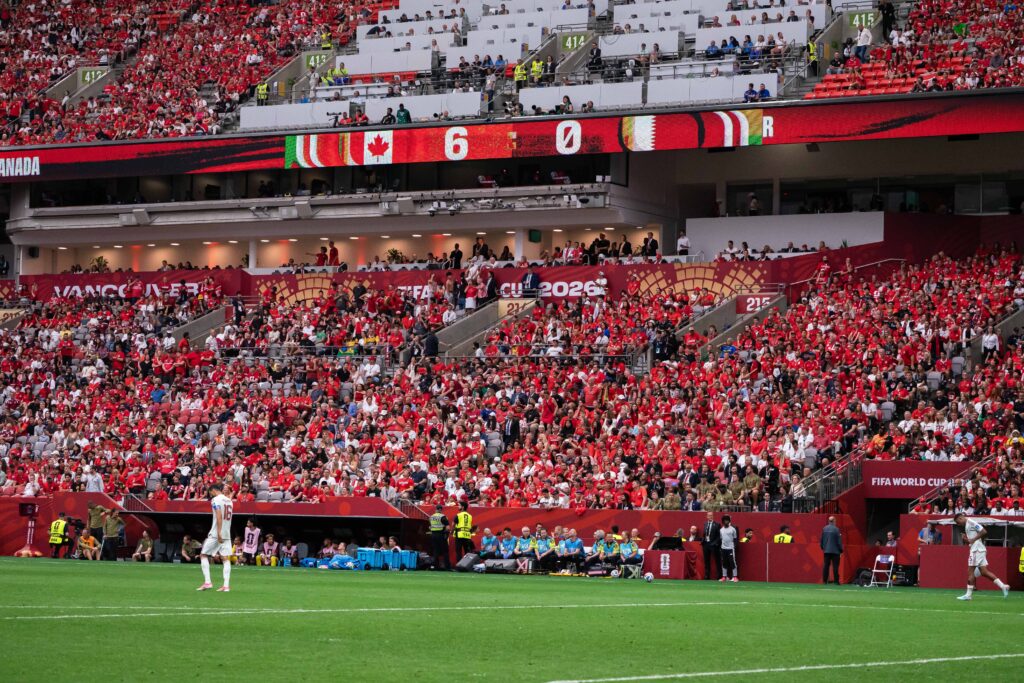
And now the German soccer world is looking toward Toronto: There, the DFB team will play its second group stage match against Ivory Coast on Saturday. Germany will travel to the match in Toronto from its World Cup base in Winston-Salem, North Carolina, near Charlotte. The national teams of Canada and Germany have faced each other only twice so far, with Germany winning both matches. In 2003, Germany won a friendly against Canada 4–1 in Wolfsburg, and in 1994, during preparations for the World Cup in the U.S., Germany won 2–0 in Toronto—with goals by Matthias Sammer and Rudi Völler.

The 2026 World Cup is expected to lead to a further upswing in Canadian soccer. The men’s team wants to finally shine on the World Cup stage and step out of the shadow of the successful women’s teams. As early as the “bid book” that the U.S., Mexico, and Canada submitted to the FIFA Congress in Moscow eight years ago as part of their bid, Canada had set the goal of bringing men’s soccer to the same level of success as women’s soccer. The Canadian men’s team has qualified only twice—for the 1986 World Cup in Mexico and for the 2022 World Cup in Qatar. In both tournaments, they were eliminated after the group stage—each time without a single point and having scored only two goals in a total of six World Cup matches. That’s different now. Canada, automatically qualified for the World Cup as the host nation, first faced Bosnia and Herzegovina in Toronto and then Qatar in Vancouver in Group B. The final group match against Switzerland on June 24 will also take place in Vancouver. The big goal: advancing to the knockout stage, the round of 32. If Canada were to win the group with a win or a tie against Switzerland, it would then also play its first game of the knockout round in Vancouver.

(© picture alliance | Xinhua News Agency | Meng Yongmin)
Canada’s national team coach, Jesse Marsch—an American—is convinced that his team is ready to “make the country proud.” His players are proud to “wear Canada on their chests,” Marsch said as he introduced his team. Jesse Marsch took over as head coach of Canada in 2024. Under Ralf Rangnick, he served as an assistant coach at RB Leipzig in 2018; a year later, he became head coach at RB Salzburg and led the Austrian club to back-to-back Bundesliga championships and cup titles before returning to Leipzig.
The success of the “United Bid” by the Canada, Mexico and the U.S. may also have been due in part to the young player Canada sent to the FIFA stage for the presentation: Alphonso Davies, then 17 years old, a refugee from Africa and a player for the Vancouver Whitecaps. “When I was five years old, a country called Canada welcomed us,” he said. “I know the people of North America will welcome you,” he told the delegates. The boys on the soccer teams had accepted him, and now he was proud to be able to play for Canada’s national team as a Canadian. “My dream is to compete in the World Cup one day.” He did not play in Canada’s opening game on June 12 against Bosnia and Herzegovina or in the game against Qatar.
In addition to Alphonso Davies, who currently plays for Bayern Munich, the Canadian team features players who hold key positions in European leagues and in North America’s Major League Soccer. Jonathan David, a forward, has been playing for Juventus Turin since July 2025, where he has a contract through 2030. Alistair Johnston (Celtic Glasgow), Derek Cornelius (Olympique Marseille/Glasgow Rangers), Ralph Priso (Vancouver Whitecaps), Jacob Schaffelburg (Los Angeles FC), Tani Oluwaseyi (Villarreal CF), Richie Laryea (Toronto FC), and Nathan Saliba (Anderlecht) are other players on the roster.

All countries playing in Canada will be cheered on by strong ethnic communities there; in Vancouver, three First Nations from the greater Vancouver area will also serve as co-host nations. Toronto Mayor Olivia Chow explains her city’s cosmopolitan nature: “More than half of our population was born outside Canada.” The Toronto region is home to people from more than 200 ethnic groups, and around 170 different languages are spoken there. Toronto sees itself as “the world in one city,” and the city’s motto, enshrined in its coat of arms, sums it up: “Diversity Our Strength.”